Thứ Hai, 25 tháng 7, 2016

South African rally driver Gugu Zulu dies


Story highlights
  • Rally car driver Gugu Zulu has died
  • Reports state he was hospitalized after attempting to climb Mount Kilimanjaro
Johannesburg (CNN)Celebrated South African rally driver Gugu Zulu has died following an attempt to climb Mount Kilimanjaro during a charity event honoring Nelson Mandela.
A spokesman for the Nelson Mandela Foundation confirmed Zulu was attempting to reach the summit with his wife Letshego when he encountered breathing problems. "Details are sketchy. What we do know is that Gugu experienced problems breathing. The medical team supporting the trek put him on a drip and they descended the mountain with him. We are informed that the medical teams tried everything possible to save his life," they said in a statement.
    The Foundation's CEO Sello Hatang said in the statement: "I am devastated. I recruited him to climb Kilimanjaro. The last thing he said to me at the airport before he left last week was that he wanted to speak about doing other Mandela Day projects. I feel a huge sense of loss."
    Zulu and his wife were among 46 South Africans who took part in the #Trek4Mandela initiative that aims to raise funds to ensure that impoverished girls do not miss a day of school due to menstrual problems.
    Among those who expressed their grief was South Africa's Minister of Sport and Recreation Fikile Mbalula, who said Zulu's death, was "tragic news." SuperSport Presenter Xola Ntshanga tweeted "Take solace from the fact that he was with someone he loved, doing something amazing."
    Twitter user @lebolukewarm wrote "RIP Gugu Zulu who passed away on Mnt. Kilimanjaro, you were an inspiration to many and @AlutaMaqoko wrote: "RIP fastest brother in Africa."Zulu, who was sometimes referred to as "the fastest man in Africa," was a three-time winner of the South African National Rally Class Championships in 2007, 2009 and 2010.
    In a media statement, South Africa's President Jacob Zuma extended his deepest condolences. "We are deeply saddened by this tragic and painful incident which has taken place on a day on which we should be rejoicing and celebrating Madiba's legacy," he said. "South Africa has lost an inspirational young man who was not only an adventure enthusiast, but was also passionate about community initiatives aimed at improving the lives of others."
    July 18 is Mandela Day, a United Nations day to commemorate the former South African president.

    The French’s Love of Brooklyn Translates to the Luxury Sales Market

    With its top-notch schools and restaurants as draws, ‘Little Paris’ is springing up in the borough

    Boerum Hill, Cobble Hill and Carroll Gardens—three adjacent neighborhoods in Brooklyn—used to be known just by their actual names. Then real estate developers began referring to the area as BoCoCa as a marketing tool for selling new condos to Manhattanites in search of more space for less money. But now, the area southwest of downtown Brooklyn has a new moniker—“Little France,” or “Little Paris,” depending on whom you’re speaking to.
    The emergence of several dual-language public schools in the area, followed by French shops and restaurants such as Provence en Boite and Bien Cuit, have over the past few years attracted quite the community of French nationals who have taken up residence in the neighborhood. The number of French vacationers visiting Brooklyn is also on the rise.
    While it is true that French-speaking expats in New York City—thought to total around 180,000, when including patois and cajun—live all over, Brooklyn has a particularly large enclave, with around 3,000 French families estimated to be living in Carroll Gardens alone, according to the French Embassy.
    MORE: In Honor of Bastille Day, 5 Paris Homes With Views of the Eiffel Tower
    As a result, one of the biggest Bastille Day celebrations outside France was held on restaurant-filled Smith Street in Carroll Gardens, traditionally an Italian neighborhood. The organizer even took the extra step of covering the street with sand so revelers could enjoy playing pétanque, a classic French game.
    Bastille Day celebrations in Carroll Gardens.
    Bar Tabac
    Eric Heras, a broker at Corcoran who specializes in selling Brooklyn brownstones and whose wife is a teacher at Public School 58, believes the area’s popularity is firmly rooted in its schools.
    “Everybody used to want to transfer to P.S. 29, and then this dual language program started and just keeps getting more popular,” he said.
    French buyers discover life outside Manhattan
    Now, it seems that wealthier French families are beginning to jump on the bandwagon— agents report that even French finance industry employees, who have long favored Manhattan, are starting to slowly trickle through to these neighborhoods.
    MORE: Brexit Could Have French Heading Home
    “We’re seeing the most demand from French buyers in Carroll Gardens because you have the most amazing French program at the International School of Brooklyn, as well as all the great French restaurants such as Chez Moi on Atlantic Avenue,” said Greg McHale, a real estate agent at Compass. “You can’t go to the park without hearing at least three or four conversations in French.”
    Many of his French clients want brownstones in the $3 million to $4 million range, but developers of new condominium buildings with good amenities in neighboring Boerum Hill have also seen an increase in inquiries from French buyers.
    A French family just purchased a property at The Nevins, a 21-story building being developed in Boerum Hill by the Naveh Shuster Group that will have 73 residences, and where a two-bedroom property will set you back $1.15 million. Amenities will include a 24-hour attended lobby, rooftop terrace, fitness room and children’s playroom.
    Tamir Shemesh, a Corcoran broker who is handling sales for the building, said: “We have definitely seen interest from French buyers, and one family in particular … is moving from Manhattan because they love the neighborhood.”
    Blake Dinour, a sales agent at The Hendrik, a new upmarket development in Boerum Hill, said she believes the area has become more family-friendly in recent years. The condo’s 33 units range from $1.75 million for a two-bedroom to $2.9 million for a four-bedroom—and more than half will have private outdoor spaces of as much as 1,140 square feet. Ms. Dinour said she believes the large apartments are attracting families who would normally go for a townhouse, but want amenities. A number of the prospective buyers have been French.
    But it’s not just BoCoCa
    Williamsburg in Brooklyn, is also an attractive option, especially for Parisians, according to Jacques Cohen, an agent at Compass, who just closed on a sale with a French couple. They live in Paris and recently sold their pied-a-terre in Long Island City, Queens, to buy the Williamsburg home, which they plan to use as their primary residence when they move to the U.S. in the near future.
    “Instead of taking profits from the most recent sale and putting it into Manhattan, they bought it in Williamsburg. It really attracts the French,” Mr. Cohen said. “The St. Germain neighborhood in Paris is known for its hipster culture, which is similar to Williamsburg.”
    French buyers are snapping up properties in other parts of Brooklyn as well. Mr. McHale told Mansion Global that he recently oversaw the sale of a property in Clinton Hill to a French family so they could be closer to their son’s school, which has a great French-language program. Another French couple he worked with just bought a pied-a-terre in downtown Brooklyn.
    MORE FROM MANSION GLOBAL:

    Is Baton Rouge protest photo really iconic?

    Attack dogs unleashed in Birmingham, Alabama, in 1963; the Tiananmen Square tank standoff in 1989; an Egyptian protester in a blue bra being beaten in Cairo in 2011 — all iconic images now associated with historical moments in time.
    But what makes an image iconic?
      The true iconic image is rare and unlike any other. It is the sum total of many elements, vetted against cultural, professional and historic standards.
      Kenny Irby
      It carries the weight of an entire story, even movement, in one photograph. It transports. Audiences instantly share it and reporters tell stories using it as a critical visual backdrop.
      Right now, across social media and embedded in mainstream media coverage, people are discussing a powerful, decisive moment documented by Jonathan Bachman of Reuters.

      On a humid Sunday afternoon in July, Bachman captured Ieshia Evans, 35, in a flowing gray spotted summer dress (what members of the African-American community might call her "Sunday's best"), defiantly standing her ground during a Baton Rouge protest against police officers in riot gear.
      She had joined dozens of protesters along Baton Rouge's Airline Highway to denounce the death four days earlier of Alton Sterling, shot by police outside a local convenience store. Many protesters carried signs. A few shouted into bullhorns. And some were reported to have armed themselves with guns.
      Later arrested, Evans joined a long list of American citizens apprehended for exercising her right to participate in civil disobedience, to stand for justice denied.
      Like so many photographs quickly tagged by the media as "iconic," this image has inspired a flurry of articles, commentary and online discourse.
      Is it iconic?
      Evans can certainly be seen to represent a certain peace amid a storm of protest against injustice, a storm that is rippling as a wave across our not so United States of America.
      Iconic images that changed the world 02:25
      In the era of #BlackLivesMatter, she is a maiden of grace, reminiscent of a Statue of Liberty-like figure, unflappably standing her ground before an animated flurry of armed-to-the-teeth police officers, protesters and bystanders.
      In a fraction of a second she embodied a special quality of guts and courage: "grace under pressure," is how Ernest Hemingway defined it.
      Some see in this photographic image a reminder of other photographs indelibly etched in their photographic memories. The contrast recalls images of the stand-off between a man and a tank in Tiananmen Square in 1989, or the determination of Rosa Parks in refusing to give up her seat on a segregated city bus in 1955.
      Black skin: A uniform we can't take off
      Black skin: A uniform we can't take off (Opinion)
      For me, Bachman's image bears an eerie resemblance to one made by Oded Balilty of the Associated Press. Itwon the 2007 Pulitzer Prize for breaking news photography, and showed a lone Jewish woman defying heavily armed Israeli security forces as they attempted to demolish the homes of illegal settlers in the West Bank.
      Bachman told Buzzfeed that his photo "was the first image I transferred [to Reuters] because I knew it was going to be an important photo ... you can take images of plenty of people getting arrested, but I think this one speaks more to the movement and what the demonstrators are trying to accomplish here in Baton Rouge."
      Truth be told, it's too early to label Bachman's photograph iconic. It has yet to be measured against a broader body of photographic works, juried in the photojournalism world of contests, or evaluated by historians and pundits in academic halls.
      But without question, this image of grace under pressure is memorably arresting.

      America's Cup: The building of the 'beasts' in Oracle Team USA

      They are among the world's toughest athletes -- men for whom some of the most grueling training imaginable is all part of the routine.
      For the "beasts" of the Oracle Team USA America's Cup crew and those who work with them, the pursuit of peak condition is as relentless as the races in which they push themselves to the limits.
        Punishing gym regimes -- they push weights around as well as merely lifting them -- swimming and boxing are key to making these extreme sailors as ready to defend their America's Cup title next year in Bermuda as they can be.
        And for the man overseeing it all, physical performance manager Craig McFarlane, there is the pride of helping his charges to be "absolutely the best at what they are doing."
        They are among the world's toughest athletes -- men for whom some of the most grueling training imaginable is all part of the routine.
        For the "beasts" of the Oracle Team USA America's Cup crew and those who work with them, the pursuit of peak condition is as relentless as the races in which they push themselves to the limits.
          Punishing gym regimes -- they push weights around as well as merely lifting them -- swimming and boxing are key to making these extreme sailors as ready to defend their America's Cup title next year in Bermuda as they can be.
          And for the man overseeing it all, physical performance manager Craig McFarlane, there is the pride of helping his charges to be "absolutely the best at what they are doing."
          "They are very competitive -- there's no shortage of that. We do a lot of competitive stuff and break down some barriers. We embarrass them now and again.
          "Once you humiliate yourself a couple of times, make fun of yourself, you've broken down a few barriers."
          The nature of McFarlane's training is governed by the nature of the boats raced in the America's Cup -- "the new boats are very physical, so we are improving physically until the Americas Cup comes in 2017" -- and he says it brings huge rewards.
          "They are all professional athletes, they are motivated to train -- and so as long as they are hitting their numbers and improving, then I'm probably doing my job," McFarlane explains.
          "When you see them out on the boat, it is even more impressive. It is just phenomenal seeing them in their environment. They are absolutely the best at what they are doing.
          "You do your job in here, but you don't know how it's going to translate out on the water. But you like to think the physical side is prevalent."
          Boxing, overseen by coach Brent Humphreys, is a big part of that physical side.
          But why does it help you become a better sailor?
          Skipper Jimmy Spithill -- who led Team USA to an astonishing 2013 America's Cup comeback when it roared back from 8-1 down to defeat New Zealand 9-8 -- says fight training helps the crew think more sharply when exhausted and under pressure.
          The Australian, who swaps the water for the air as a pilot in his spare time and had the idea of introducing boxing to the training regime, is more than happy to ride with the punches.

          Airline cabins of the future: A new golden age of travel?

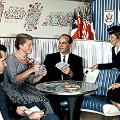
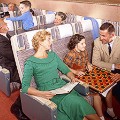
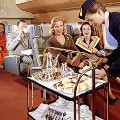
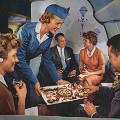
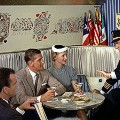
          Air travel photos from the 1960s show smartly dressed, champagne-sipping passengers in spacious airliner cabins.
          Contrast that with today's cramped seats and overcrowded airports and it looks like our flying experiences are getting steadily worse.
            But is this based on reality?
            The aviation industry has been investing massively to prove nostalgic travelers wrong.
            Yes, aircraft may still look similar to those of the so-called golden years.
            But every single aspect of the air travel experience is currently being overhauled -- all driven by technology.
            Right at the forefront are airplane cabins.
            And key to their transformation is wireless connectivity.
            With virtually every passenger toting a smartphone, tablet or laptop, inflight Wi-Fi is opening up new ways to engage with air travelers and redefine the flying experience.

            Personalized inflight entertainment

            Panasonic's Waterfront system  allows passengers to use their mobile devices to control an aircraft's built-in entertainment.
            Mobile tech already plays an important role in enhancing travel, from electronic boarding passes to last-minute bids on biz class upgrades.
            Some airlines, such as KLM, have even started sending boarding passes and flight alerts through a dedicated airline Facebook Messenger chat bot.

            But the one area where mobile can become truly transformative is inflight entertainment, with personal devices becoming gateways to a whole range of up-in-the-air services.

            While built-in in-flight entertainment systems are unlikely to vanish, particularly on long-haul flights, they can work in tandem with the passenger's own devices.
            Earlier in 2016, Panasonic unveiled Waterfront, a system that allows the passengers to use their mobile handsets to control an aircraft's built-in entertainment.
            Aerospace companies Thales and B/E are also using mobiles to personalize passenger experiences.
            By syncing with handsets, their seats know a passenger's preferences and can even restart a movie at the exact place where they left it in the previous flight.
            Some airlines are doing away with embedded entertainment systems altogether.
            They're opting for passenger's handsets to deliver inflight entertainment -- a move that crucially reduces aircraft weight and frees up cabin space.
            No Internet connection is required, passengers just connect their devices to an in-plane network.

            Captive audience

            Thales and B/E's Digital Sky seats make use of larger, higher-res screens.
            Netherlands-based AirFi is primarily equipping low-cost airlines that often fly short-haul single-aisle aircraft and don't have entertainment systems.
            The company's portable wireless system beams pre-loaded content onto passenger devices.
            The AirFi terminal behaves like a normal Internet router. It's lightweight and can easily be installed in a luggage compartment.
            AirFi CEO Job Heimerikx says it's a cost effective and flexible way to provide quality inflight content to the short haul market.
            "There are a customer service and a commercial angle to our system," he says.
            "Passengers can access a broad range of movies and other sort of entertainment, but they can also use it to order food or shop duty free.
            "It's like an evolution of the traditional inflight magazine, but just as it happens at online stores, you can make it really personal."
            This concept thrives on having a captive audience.
            But would it still work if users had a full inflight broadband Internet connection?
            Passengers might be more interested in binge-watching their favorite TV series instead of booking airport transfers or ordering an extra cup of coffee.
            MORE: 5 wow moments from greatest airshow

            Virtual reality

            AirFi offers a cheap alternative to inflight entertainment systems, streaming direct to phones and tablets.
            "If airlines can't stop the passenger from going to Amazon or zoning out on Netflix for three hours... and they can't offer something at least equally interesting in terms of intuitive retail and custom content, they are missing a number of tricks" says Maryann Simson of Runway Girl Network, a leading aviation news website focusing on passenger experience.
            It's a theory that'll get put to the test soon.
            Aeromexico recently announced it would use Gogo's 2Ku satellite-based Internet connection to offer Netflix-enabled flights.
            "More than 80% of passengers are walking on the plane with their own device," Gogo exec Ash ElDifrawi points out.
            "Airlines can save the weight and maintenance costs of legacy seat-back entertainment systems and still provide differentiated experiences.
            "For example, they can now create custom portals that create a unique brand and advertising opportunity for the airlines."
            Internet connections are only the beginning.
            Both Transavia, a low cost subsidiary of Air France/KLM, and Australian carrier Qantas have been testing virtual reality technology as an alternative to traditional in flight entertainment.
            VR could offer not only entertainment but also help calm those afraid of flying.
            Transavia also sees virtual reality sets as a potential source of extra cash, perhaps offered as a premium service.
            Daan Noordeloos, manager marketing and customer strategies for Transavia, says tests have so far proved positive.
            "We are evaluating ways to continue it and make it part of our regular inflight offering," he adds.